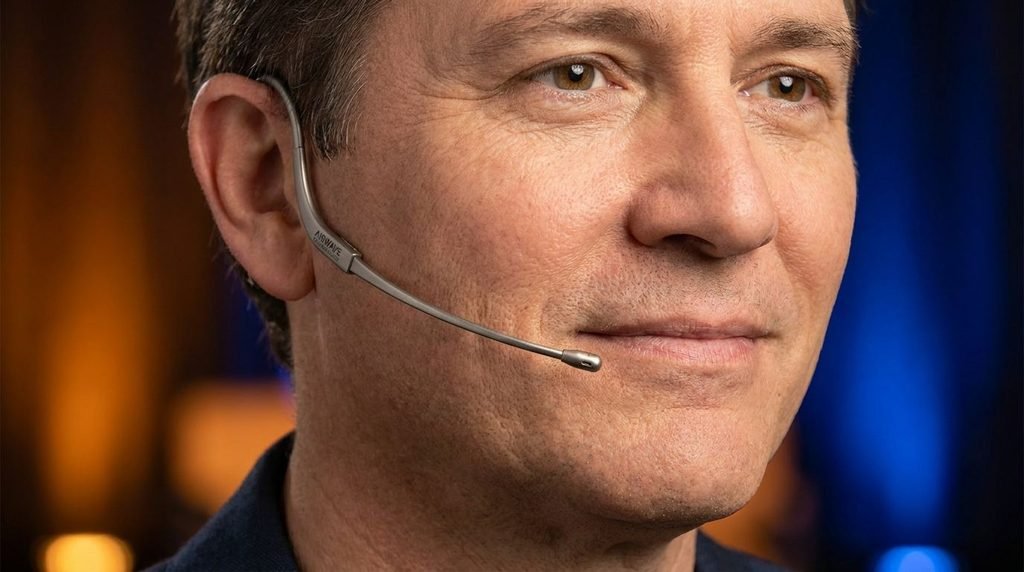
Ever seen someone presenting, acting or leading worship service whose voice comes through clear and yet his hands remain totally free? He most likely had one of those little devices called headset microphones working for him. One of the headsets that comes up frequently in discussion about discreet and light headsets for stage presentations and speeches is the Airwave Technologies HSD-Titanium Headset Microphone.
Here’s where we look at what it is, what its technical specifications tell us, who can use it, and what to consider before settling for one. It should be mentioned that I have never used this particular microphone, so I will just go by information available from the manufacturer through reputable retailers.
What Is the HSD-Titanium?
HSD-Titanium is a one-ear headset microphone. It has been described by retailers as an ultra-light, professional microphone with a European omni-directional capsule, which features a removable cable. The microphone is covered by a limited one-year warranty from Airwave Technologies, according to the retailers’ information.
The device is supposed to be used for hands-free talking and performance. B&H notes that the similar Slimclip is a light-weight, mini headset that is used for television, theatre, stage, or any situation that requires hands-free use with low visibility.
Key Attributes
These are the characteristics as presented in the publications.
Omnidirectional capsule. It captures sound waves from any direction. As per B&H, this feature ensures that one gets crisp and natural sounding speech and vocals even without direct face-to-face position.
Ultra-lightweight. Comfort during use for a long period is emphasized in all listings. The boom arm is also said to be flexible to suit any user.
Cable can be detached. This makes it possible to replace the cable alone hence extending the life of the device and also allowing its use with different transmitters.
Colors. They are available in tan and black colors and according to B&H; the cocoa color is also available. These colors are favored as they blend well with the skin color when on stage or in front of the camera.
Signal to noise ratio. Signal to noise ratio for the Shure compatible model is above 58 dB.
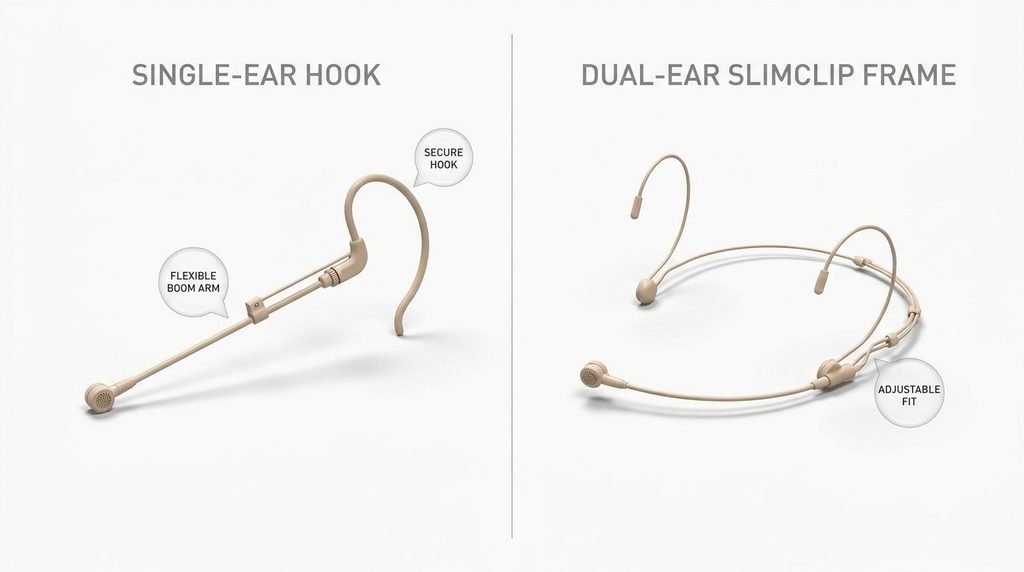
The Slimclip System: One Earpiece or Two-Earpieces?
Another headset available is the HSD-Titanium Slimclip system. It is a two-earpiece model that comes with an HSD-Slimclip attachment that allows keeping the microphone stationary regardless of how much the presenter moves around. According to the listing, one can change it into a one-earpiece headset by removing the attachment.
Thus, the Slimclip headset will be suitable for those who fear the headset can move while walking or speaking actively, such as physical trainers, dancers, actors, and dynamic presenters. In case you mostly stand and speak, the regular one-earpiece version might suffice.
Connectors: The Part that Confuses People
It is the key buying factor, so here’s a brief on it. Headset microphones don’t use one and only one connector for their transmitters. The HSD-Titanium range of products comes in different connectors, which are:
- Shure (T4)
- Sennheiser (S8)
- Audio-Technica cW (3rd generation)
- Audio-Technica cH (4th generation)
- Electro-Voice and Telex
- T3 connector models
- Hardwire XLR adapter
The above list comes from the connector variations available in retailer listings. In case you order an incompatible connector, it means the headset microphone won’t be usable with your transmitter; and in some cases, it can be even problematic. Therefore, prior to ordering, I would recommend checking at least three points: the exact model of your bodypack transmitter, its connector and the compatibility notice in the product listing.
On Noise Cancellation
Certain product pages for this headset have suggested that the headset has great noise cancellation capabilities. That’s something to take a second look at. An omnidirectional capsule captures sound coming in from all sides, and therefore it is not a noise-cancelling device like a directional or noise-cancelling microphone. Rather, the true benefit of a headset is quite different: due to the fact that the capsule is located close to the speaker’s mouth, his/her voice is louder than any surrounding noise.
Or, in other words, do not expect noise cancellation but great sound pickup in general. If you use this microphone in very noisy settings, test it first in those conditions.
Who Is It Best For?
Taking into account the above-mentioned descriptions, I can assume that the HSD-Titanium is perfect for:
- Presenters and trainers looking for a microphone that will allow them to walk freely and use their hands.
- Worship leaders and speakers who appreciate a discrete headsets.
- Performers in theatre and onstage who require a lightweight and discreet microphone.
- Broadcasters and video presenters in need of an inconspicuous headset.
- The rental companies and events centers where connector changeability and replaceable cables matter.
Should you be looking for a rugged microphone that will stand a lot of sweat and intense daily work, make sure you consider durability and the possibility of purchasing spare parts. Also, should you require a directional microphone in a noisy environment with close loud monitors, you may face some bleed with omni-directional headset.
Single Ear or Slimclip? An Easy Guide to Choose
- Should you want maximum comfort and a minimal design with moderate movement, then choose single ear.
- Should you move a lot, jump, dance and/or turn around frequently and you want more stability, then choose the dual-ear Slimclip version.
The latter option can be also converted to single-ear type, so you have a chance to be flexible.
What Buying Tips Would I Follow
- Match connector precisely. It’s the main cause of errors.
- Select appropriate color. Use tan or cocoa with light skin tones and in-camera use, and black for dark ones.
- Verify package contents. Make sure you have the cables, clips, windscreens and a carry case.
- Be aware about warranty and return policy. Listings claim that you get one-year limited warranty, but policies are different from sellers.
- Perform sound check in advance. In the same room and with your own transmitter.
- Have a backup. For an important event, it’s better to keep an additional headset or cable.
- Since prices may vary, retailers offer discounts, I won’t name one here.
Mistakes to Be Kept Away from
- Buying it without inspecting the connector. This is the biggest mistake.
- Aspiring for the isolation that one can get in studios. It is a headset microphone, not a recording studio.
- Misplacing the capsule. It would be better to place it close to the mouth corner, not facing the mouth.
- Forgetting about a wind and sweat strategy. It is necessary to use a windscreen and maintain cleanliness of the microphone.
- Following all marketing statements blindly.
Conclusion
The Airwave Technologies HSD-Titanium headset microphone was created for people in need of a light, inconspicuous, hands-free microphone with flexible compatibility. Key features of the device are the omnidirectional capsule, ergonomic design, detachable cable, and plenty of connectors. What you have to focus on is the correct selection of the connector in relation to the transmitter.
Recommendation: Before purchase, make sure to note the model of the transmitter, decide on the level of mobility and select either single-ear or Slimclip configuration.
As the owner of the audio, rental or events company, interested in automation of quoting, booking and follow-up of the customers, please feel free to check our services offered by Aura Flow Tech.
Sources
- HSD-Titanium Omni-Directional Headset Microphone, Tan, Sennheiser S8 (Adorama)
- HSD-Titanium Single Ear Headset Microphone, T4 Shure, Black (Adorama)
- HSD-Titanium Slimclip System, Cocoa, Audio Technica cW (B&H)
- HSD-Titanium Slim Clip, T4 Shure, Black (Adorama)
- HSD-Slimclip Dual-Ear Headset Microphone, Audio Technica G4 (Adorama)
- HSD-Titanium Headset Microphone, AT Compatible, Tan (Adorama)
- HSD-Slimclip connector options, Audio Technica G3, Tan (Adorama)