Every day we get news about robots building walls, artificial intelligence managing whole sites and drones doing surveys. As someone involved in construction business, it’s sometimes difficult to figure out which news to pay attention to. I’ve read tons of construction technology news and my frank opinion on this matter is the following – some stuff really changes the way the projects are managed, others are just beginning, while there are some technologies that have been overhyped.
Here’s my no-nonsense review of what is really changing, what should be taken with a grain of salt, and what I would choose if I were in your shoes.
Big Picture: AI Transitions from Experimentation to Practicality
There is a single concept that pops up in almost all the sources that I have looked at, and it is AI. In a survey of expert forecasts compiled by Autodesk, 2026 was the year where AI would transition from being a trend for the future to becoming the industry norm, such that companies that do not use it will lose contracts to their speedier competitors.
The figures cited here are quite large. According to IFS, through Byte TI, 91% of the companies operating in construction and engineering industries are expected to expand their spending on AI in 2026, while 89% of the early adopters have recorded increased profits. However, I would take those figures with a grain of salt because they are provided by a software vendor in its report and the early adopters, by definition, are always enthusiastic.
Moreover, the outlook is not unidirectional in this case. Even in that same Autodesk summary, there was an expert who stated that they do not think that the AI technology would revolutionize construction in 2026, while some other experts raised legal liability and intellectual property issues as barriers in implementing AI in the sector.
What AI is actually being used for
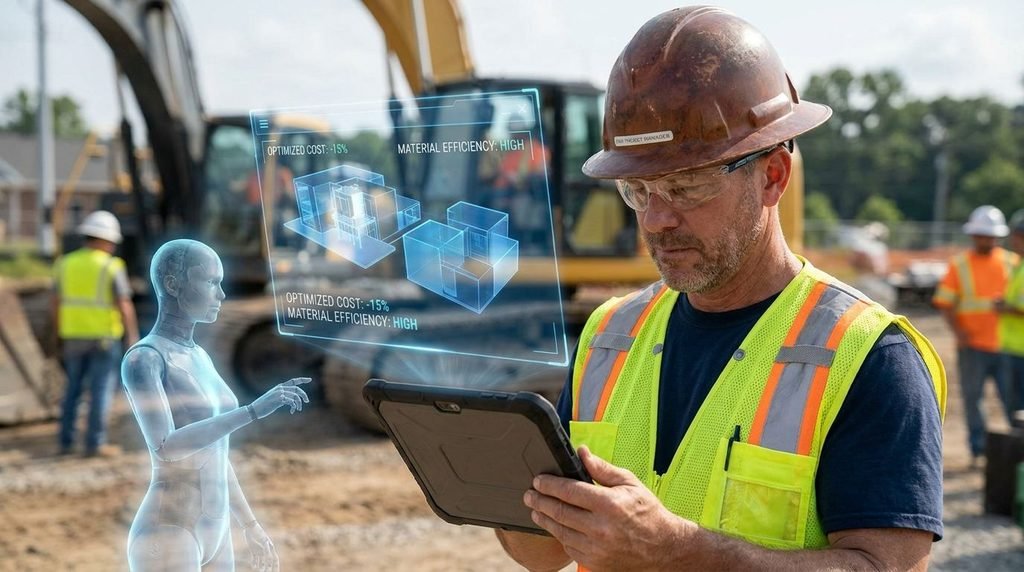
Beyond the hype, the real world applications of AI are surprisingly pragmatic. For instance, the September 2026 issue of Construction UK Magazine is focused precisely on that – adoption of AI via automated take-offs, and assistance with documents and risk management.
This is consistent with what I hear from contractors themselves, whose early successes have been in the paperwork areas of construction:
- Takeoffs and estimating. Faster data extraction from drawings.
- Review of documentation. Finding mistakes in contracts, specifications, and submittals.
- Scheduling and procurement. Some companies apply AI to analyse past projects’ data and current project conditions to schedule better and anticipate their material requirements, lead times and prices.
- Daily project management. Summaries, reports and all the paperworks that would take hours to manage before.
None of this is exciting. Everything is time-saving.
Agentic AI: The Next Phase to Watch
Another term that keeps coming up is “agentic AI.” That refers to AI that can do things like not only answering a question but completing multi-step actions.
I would keep an eye on that, since it relates directly to the workforce shortage issue outlined above. However, I would think smaller scale when implementing. AI agents dealing with contracts, payment and safety information should have rules, human oversight and logs of what they’ve done.
The Skills Shortage Is Driving Much of This
Construction technology news cannot be separated from labor news. According to one estimate quoted in Construction Business Owner, there would be a need to recruit almost half a million additional workers in 2026 alone. While one single number is not necessarily a good measure, the pressure is definitely real and discussed extensively.
That’s the reason for much of the technology discussion being about how to do more with what we’ve got: automate administration, speed up surveys and use machines for physically repetitive work.
Drones, robotics and 3D printing: For real, but unevenly so
Here lies all the eye-catching news, so caution should be exercised.
Drones. Aerial drones have been touted as the established technology for surveying and monitoring sites. This corresponds with my observations. The September edition of Construction UK also addresses the use of drones in surveying to speed up home-building. If you have not looked at drones before, they are possibly the most easily accessible technology to start with.
Robotics. Robot bricklayers, manufacturing drones and big 3D printers are entering the sites, while humanoid constructors are far into the future. Nice metaphor. Specialised machines for particular tasks exist today, while general-purpose robot constructors do not. And there are pragmatic obstacles. High initial costs are the first barrier to adoption, and robots have to comply with safety standards and requirements.
3D printing. Large-scale construction 3D printing left the laboratories and arrived at construction sites around the world by means of robotic manipulators that pour concrete or any other material according to a digital drawing. This is a promising approach, especially in certain types of buildings and prefab technology, but no game changer yet.
Compliance and Digital Records Are Turning Into a Job Requirement
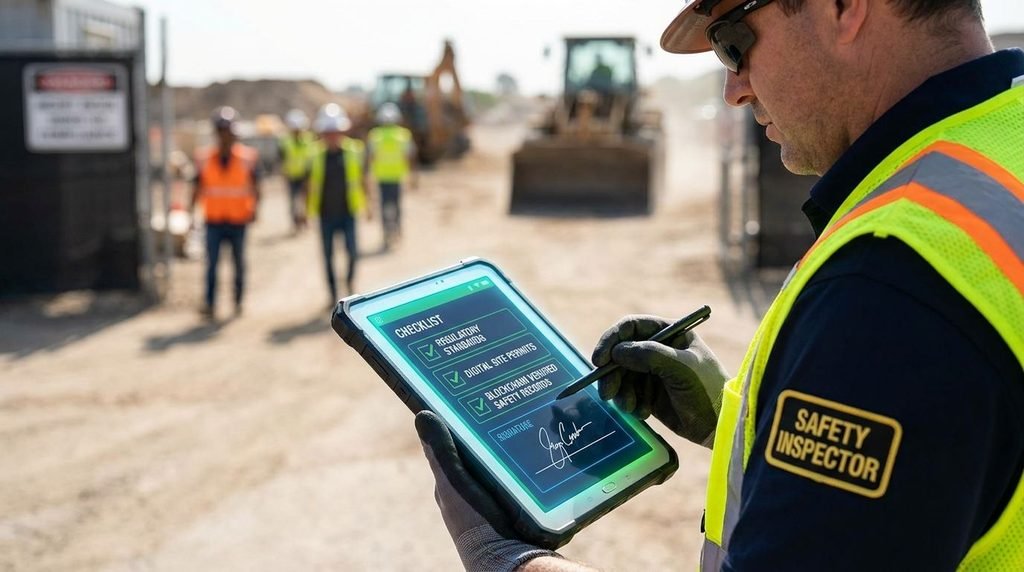
There is also non-newsworthy information. The aforementioned UK magazine issue contains an article on mandatory digital waste tracking. I mention this because it is another trend – increased traceability becomes increasingly expected, and firms with good digital records are better prepared for this compared to firms using spreadsheets and email.
Should you be operating in a different country, the relevant regulations will be different, so make sure you find out what applies to your business.
Where to Stay on Top of the News
For those who want to stay up-to-date without being overwhelmed by news, events and trade press can be helpful. For instance, the 4th Annual Construction Technology Leaders Summit takes place on 28 and 29 October 2026 in Sydney, with a focus on large-scale technology deployment that results in measurable performance gains. This phrase – measurable performance gains – is how you should approach everything in this article.
Decisions on Adoption
Consuming the news is easy. Making decisions based on the news is difficult. Let me explain my suggestions.
Step 1: Start from your biggest time waster. Whether it’s estimates, RFIs, reporting, site surveys, or approvals – choose one.
Step 2: Determine the criteria of success. For instance, “increase take-off time by one third” or “reduce reporting time from a day to an hour.” You can’t evaluate if you can’t measure.
Step 3: Evaluate your data. Your analytics and AI technologies are only as good as your drawings, documents, and numbers.
Step 4: Pilot in one project. Do not introduce a technology companywide on Day 1.
Step 5: Engage your users. Field staff will abandon any software which is going to add burden to them without increasing efficiency.
Step 6: Plan your security and liability. Understand what data flows into the software, who accesses the data, and who is liable for its outcomes.
Step 7: Evaluate and scale.
Mistakes to Avoid
- Being swayed by media hype. A good demonstration is not a good solution.
- Taking vendor stats as facts. Statistics produced by firms that produce the technology can be helpful, but should not be taken at face value.
- Automating an inefficient process. Get your processes right before automating them.
- Not training anyone. No matter how effective a solution may be, if no one is trained on how to use it, it will not work effectively.
- Forgetting about safety and regulations. Particularly with robotics and autonomous systems.
- Pushing for too much at once. Take things slowly.
Conclusion
In my opinion, the best summary of current construction technology news that I can give is this: the true innovation lies in mundane, yet practical things like estimating, documentation, scheduling, drone surveying, and record keeping. More spectacular stuff, such as autonomous sites or humanoid builders, will probably come in the future. It is not the companies that pursue each piece of news that gain from technological innovations, but those that focus on solving one particular issue by using technology in a careful manner and then analysing the results.
Here’s the tip: this week, let your team think about the task that they would like not to perform anymore, because there’s a big chance that technology could solve that problem for them.
If you need help with building your workflow into an automated and reliable process, feel free to check out what we offer at Aura Flow Tech.
Sources
- 4th Annual Construction Technology Leaders Summit (BCA)
- 2026 AI Construction Trends: 25+ Experts Share Insights (Autodesk)
- Nine out of ten construction companies plan to increase their investment in AI by 2026 (ITeC)
- The Biggest Tech & Construction Trends to Watch in 2026 (Construction Business Owner)
- Construction UK Magazine, September 2026
- 9 Ways the Construction Industry Is Adapting with AI in 2026 (Neuroject)
- Breaking Ground to Groundbreaking: A 2026 Look at Robotics in Construction (Automate)
- 5 robotic technologies redefining 21st-century construction (Imnovation Hub)
- Building the Future: How Robotics Is Revolutionizing Construction (Automate)