It seems like people either consider blockchain the future of finance or an inflated database buzzword. Being aware of how the technology has gone from cryptocurrency talk to a topic of discussion for corporate boards, I find myself somewhere in-between. It doesn’t provide magical solutions, but it definitely deals with a few issues quite effectively.
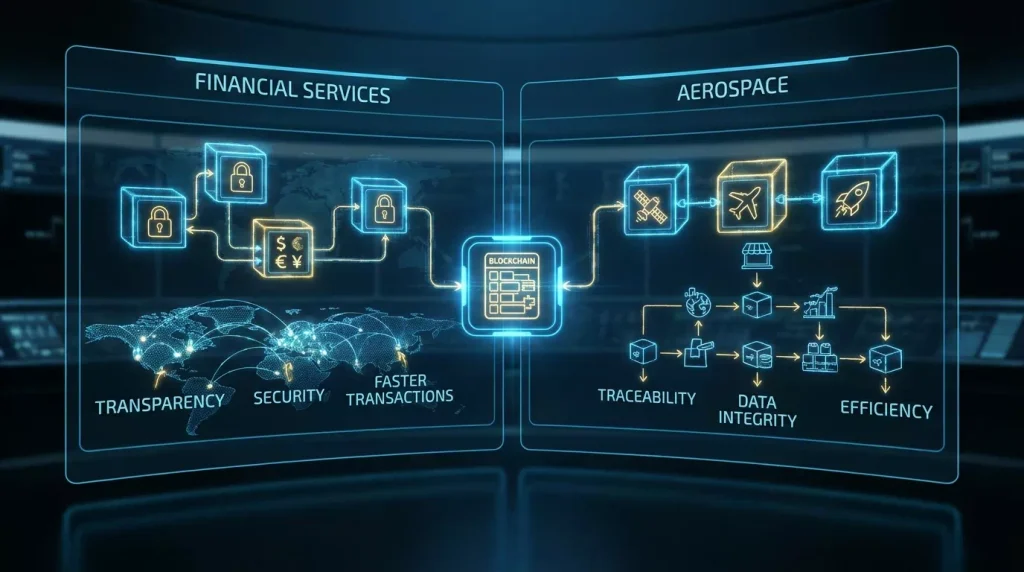
However, regardless of the industries that have been discussed above, there are two particular sectors where blockchain comes to mind when we talk about potential application areas. These are banking and aerospace and defense. Both are completely different from each other but still require something similar – trust between the players and unalterable records. In this guide, I’ll tell you about blockchain technology in financial services and blockchain technology in aerospace and defense market.
Blockchain Defined
Imagine a record book which multiple companies can read and update, but no one can alter in secret. New entries always build upon previous ones, and it would be immediately apparent if anyone altered the historical data. Include in this the use of smart contracts – little programs that execute automatically under certain circumstances – and you have a system that can document, authenticate and even enforce agreements without a third party checking each step.
The crucial part isn’t the technology itself. It’s the ability for organisations to keep tamper-evident shared records without using a single database.
Blockchain Technology in Finance
Finance is all about intermediaries, reconciliations, and patience. That is why finance has been one of the first sectors to get serious about blockchain technology. Here is what I see as the most interesting use cases for blockchain technology in finance:
- Payment and settlements. International payments usually involve multiple banks and require some time. The idea of blockchain technology would be to shorten that process.
- Tokenization. Fund, bonds, or property assets can be digitized, which would enable easier and more flexible transactions.
- Trade financing. Paper processes between exporter, importer, bank, and shipper would be less cumbersome with blockchain technology.
- Identity and Know Your Customer. Information about customers would be shared between institutions with consent instead of being gathered from scratch.
- Smart Contracts. Automatic execution of agreements such as payments once the delivery of goods is confirmed.
- Digital Currency. Stable coins and central bank digital currency pilot projects look into digital money transfers.
The upside promises speed, less reconciliation, better audit trails, and reduced manual error. The reality of the problem is equally true: regulation differs according to each nation and continues to evolve. There may be incompatibilities between different blockchains. Privacy remains an issue, as financial information is sensitive and everything cannot be placed on a distributed ledger. Finally, many banks have old core systems that are difficult to integrate into anything new.
Blockchain Technology in the Aerospace and Defense Industry
The aerospace and defense industry is a very different environment, but the problem is fundamentally the same: numerous contractors, suppliers and agencies require secure information sharing over the very lengthy lifecycle of products.
These are some of the applications that are commonly considered:
- Traceability of components. An airplane is composed of thousands of individual parts. The ability to have an immutable record of manufacturing, testing and installation is useful for combatting the issue of counterfeit parts, as well as safety.
- Maintenance record keeping. Airplanes and equipment may run for decades. Having a consistent, immutable history of maintenance is important for building trust when the asset changes ownership or operators.
- Supply chain visibility. Multi-tier, complex supply chains are better served by having visibility into component status and certificates of manufacture.
- Data exchanges. Prime contractors, subcontractors and government buyers require secure data exchanges, which can be facilitated by a distributed ledger technology.
- Contracts and milestones. Smart contracts could be used for milestone payments and compliance verification of major projects.
Most of these are in the pilot phase still, and I would be skeptical of claims regarding widespread implementation.
There are substantial obstacles to implementation. Classified data cannot be placed on just any network; therefore, security and access controls must come first. Regulations in the aviation and defense sectors are thorough and time-consuming. The integration of legacy systems and long life cycles of the equipment pose other barriers. Also, the customers are likely to question the need for something special when a regular secure database can suffice.
Similarities between the two sectors
Although there may be many differences between finance and aerospace industries, the two sectors have a lot in common as follows:
- Many organizations require a standard version of the truth.
- It is important for auditing due to costliness of mistakes and regulatory questions.
- Bureaucracy and reconciliation are time-consuming processes.
- Requirements regarding security and compliance are crucial.
If all the four criteria are present, blockchain technology can be considered seriously. Otherwise, it would not be cost-effective.
How Can AI and Automation Fit?
Blockchain stores facts. But it does not know anything about them. Here comes AI and automation – scanning, validating and cross-checking documents with the record in the blockchain and sending them further through a workflow according to certain criteria. In fact, the most successful implementations combine blockchain with intelligent automation processes around it.
How I’d Do It
If I were undertaking such an exercise for an organisation, I would proceed in this manner.
- Define the problem first. Which business process is a multi-party process involving frequent reconciliations or disagreements?
- Assess whether a blockchain is required at all. If there is only one company with control over the data, then a conventional database might be fine.
- Begin with a pilot project. Just one product line, one trade route or one parts category.
- Get the lawyers and compliance teams involved from the start. Particularly when it comes to any regulated or export-controlled data.
- Select the right kind of blockchain. Permission-based networks are prevalent in financial services and defence because participants are known and have restricted access.
- Plan on how to integrate with current processes. Otherwise the ledger is useless without the ability to connect to existing processes.
- Measure the outcome. Time savings, error reduction and resolution of disagreements.
Mistakes I Would Try to Avoid
- Focusing on the technology and not the problem: “We need blockchain technology” isn’t a use case!
- Neglecting regulations; these vary between jurisdictions and industries so seek professional advice.
- Putting too much private information on the chain, because often the best solution is to have the information elsewhere but keep just the evidence on-chain.
- Hoping for an immediate return on investment; multi-party systems take time to get into alignment.
- Skipping governance; determine who participates, who makes the decisions and who is responsible.
- Skipping people altogether; adoption needs all partners to work with the system.
Closing Thoughts
The application of blockchain technology in financial services is more advanced, with concrete experiments in payments, tokenization and trade finance. Aerospace and defense industry is somewhat younger, showing great promise in terms of traceability and record-keeping, but facing higher barriers in terms of security and certification. However, in both industries, the recipe for success is the same – choose a precise multi-party problem, test a pilot and assess by results, not by buzz.
Recommendation: Before you jump into the blockchain technology, try to write a single sentence that describes the problem and parties involved. If you cannot, you are not ready for blockchain yet.
In case you need help automating processes around your data and documents, you are always welcome to learn more about us at Aura Flow Tech.